
Your car’s Check Engine light has come on, and you’ve identified that the ECU has stored the P0172 code. Excellent. What next?
You should take your car directly to a mechanic. Yes, the situation isn’t immediately life-threatening, but the longer you leave it, the worse it’ll get. (This also means a bigger repair bill.)
Don’t take any risks. Reserve your vehicle in immediately.
In most cases, you’ll need to set aside a few substantial dollars for this repair (whatever it turns out to need).
In this comprehensive guide, I will explain what the P0172 code is, including signs, causes, fixes, and some fundamental cost estimates.
Table of ContentsShow
What Does The P0172 Engine Code Mean?

The P0172 code is defined as: System Excessively Rich (Bank 1).
In general, it means sensors have detected abundant fuel (in relation to oxygen) in the exhaust pipe (and thus in the engine).
Remember, air and fuel are mixed in (or before) entering the cylinder. Thus, the P0172 code could also mean there’s inadequate air.
In the context of ratios, terminology doesn’t make that much difference. ‘Running rich’ means there’s excess fuel compared to the air. Another way of expressing this is inadequate air compared with fuel.
These identical expressions mean the same thing.
Note: too much air compared to fuel (or too little fuel compared to air) is known as ‘running lean’.
What Is Bank 1?
“Bank 1” refers to the exhaust conduit section (left or right).
In V-engines (such as a V6 or V8), “banks” of cylinders comprise each side of the “V” setup. For example, in a V8, each bank contains four cylinders.
Each bank has its own exhaust pipe leaving the manifold. This is advantageous for flow and means you can identify on which side of the engine any problems develop.
These two banks are (creatively) referred to as Bank 1 and Bank 2. Bank 1 is the exhaust system, cat, and oxygen sensors linked to the bank containing cylinder #1.
The second bank is simply the alternate one.
Each manufacturer labels cylinders in a distinctive way. Consult your manual to determine which one it is. This will lead you to Bank 1.
Why Your Car Has A P0172 Code

Two oxygen (otherwise known as O2 or lambda) sensors are positioned in each exhaust pipe. One is before the catalytic converter (upstream, aka Sensor 1), while the other is behind it (downstream, Sensor 2).
The oxygen sensors’ combined task is to monitor the performance of the cat. This, in turn, eliminates contaminants and hydrocarbon particulates (unburnt fuel, or soot).
The readings from the oxygen sensors are transmitted to the ECM, part of the ECU. Here, the system examines them. If the readings show it’s necessary, the Check Engine light illuminates, and the DTC is stored.
The P0172 code indicates that the catalytic converter can’t eliminate all the hydrocarbons from the air simply because there’s an excessive amount of it.
Unburnt fuel, of course, comes from the engine. In this case, it comes from the bank containing cylinder #1 (Bank 1). One or more of these cylinders are ‘running wealthy’.
Symptoms Of P0172 Code
When an engine trouble code is stored, the Check Engine light glows. An OBD II reader (code scanner) can reveal what the ECU thinks has occurred.
Aside from the Check Engine light and the stored code (only visible via the scanner), you might observe any of the following:
- A strong smell of fuel (like when starting your car) all the time
- Misfires
- Low power, especially under heavy loads (hard acceleration, fast speeds)
- Black-tinged smoke from your exhaust
- A rough idle
- Poorer fuel economy than usual
- Poor emissions test performance (including failure)
These all stem from the rich fuel ratio. Too much fuel in the chamber means the combustion isn’t as efficient as it should be. This translates into all the symptoms mentioned above.
P0172 Diagnostic Trouble Code Causes
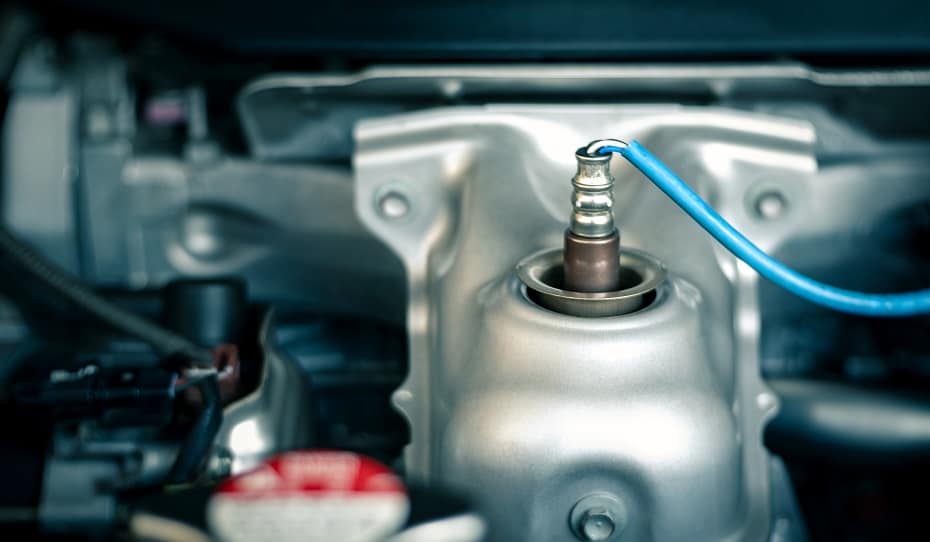
Almost anything could be causing a wealthy fuel mixture. The most common are some of the simplest to fix:
- Faulty or soot-covered oxygen sensor(s)
- Damaged spark plugs or spark plugs covered with hydrocarbon deposits (soot)
New spark plugs are a straightforward task in most cases (Boxers and certain V-engines aside). Oxygen sensors are usually fairly simple for a mechanic, too.
If these causes are eliminated, the inventory of potential causes expands considerably. The issue could lie anywhere in the ignition or exhaust mechanisms.
You should get the following inspected, although this is by no means a complete list:
- Fuel injectors
- Fuel lines
- Fuel pump
- Fuel filter
- Fuel pressure regulator
- MAF sensor
- MAP sensor
- Throttle body
- Throttle position sensor (TPS)
- Air filter and intake boot
- Coil packs
- Catalytic converter
- ECU
- Vacuum leak
How To Fix A P0172 Code
As with most emissions-related issues, the most effective solution is to go to a mechanic. They’ll have seen this sort of thing hundreds of times and can use advanced scanners to zero in on the issue.
Typically – but not always! – a fresh oxygen sensor or set of spark plugs resolves the issue.
Mechanics should use diagnostic equipment to find the component(s) that isn’t operational. This can then be replaced.
It’s also a practical idea to use cleaning services and additives. Sea Foam in the fuel tank helps clean the injectors, while a carbon cleaning service could clear out your exhaust system.
How Much Does A P0172 Code Cost To Fix?

There’s no clear-cut answer to this. Resolving a fault code is more complex than buying a single new part.
The price you’ll pay is entirely dependent on the recognized essential repair.
Here are a couple (worldwide and approximate) estimates. Keep in mind that you might require multiple of these!
- Spark plugs – $100
- Oxygen sensor – $350
- Fuel pressure regulator – $300
- Coil packs – $250 (for a whole set)
- MAF sensor – $100
- MAP sensor – $200
- Fuel system service – $80
- Carbon cleaning service – $300
- ECU inspection and reprogramming – $500 to $1,500
- Engine replacement – $3,000+
Although there are some significant numbers here, don’t lose hope just yet! Wait to see what the mechanic tells you.
Concluding Thoughts On The P0172 Code
The Check Engine light may be irritating to some, but it’s there for a purpose. Literally.
Don’t overlook it! The longer these things are left, the more serious (and the more costly!) they become.


